October 13, 2026
When Friendship Starts to Feel Like Emotional Work

Relationships & Attachment
5 minutes
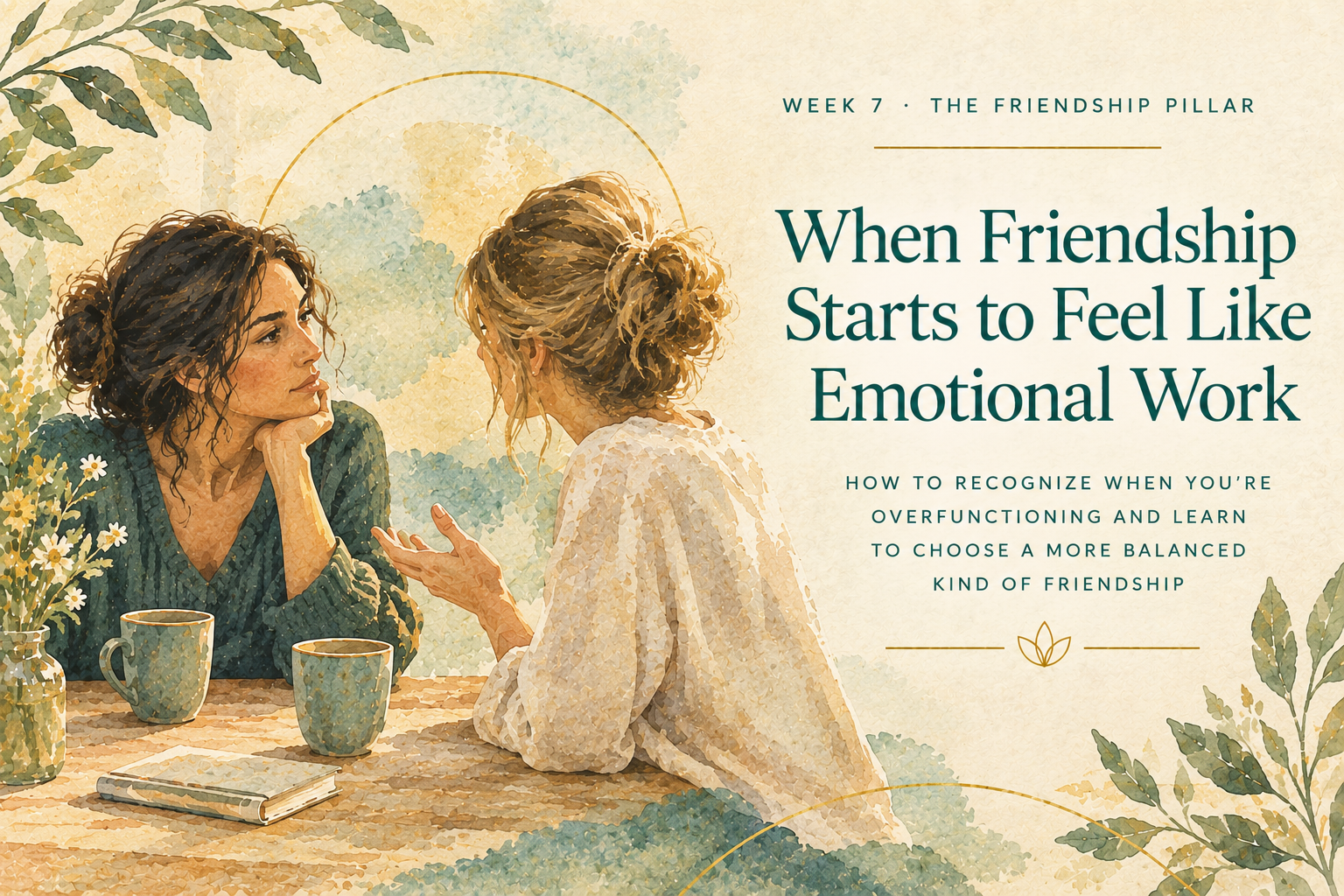
A man named Marcus knows the feeling well: a friend's name lights up his phone, and something in him sinks half a second before he even opens the message. He loves this friend. He also already knows, before reading a word, that he's about to spend the next twenty minutes holding something heavy — and that when it's his turn to need something, the conversation will somehow already be over.
That sinking feeling i's information. It's what it feels like when a friendship has quietly become one-directional, and some part of you has been keeping score long before your mind caught up.
Marcus didn't decide, consciously, to become the friend who holds everyone else's crises. It happened gradually — he was a good listener, so he listened; he was steady, so he became the steady one; he was available, so he became the default. Each individual moment felt like generosity. It was only after a few years of one particular friendship that he noticed the shape of it: he'd become its emotional infrastructure, and infrastructure doesn't usually get asked how it's doing.
This connects directly to what we talked about in Week 6. Over-functioning in friendship is often the same gap — sensing a need and not knowing how to ask for it — just wearing a different outfit. Marcus could sense, clearly, that he needed this friendship to hold him sometimes too. What was missing wasn't the awareness. It was the words, and the belief that he was allowed to say them without the friendship tipping over.
So instead, the need got managed the way it always had: quietly, alone, mostly through a resentment that leaked out sideways instead of being named directly — a shorter reply here, a missed call there, none of it ever quite adding up to a conversation.
As we discussed in Week 4, a boundary isn't a punishment — and that's especially true in friendship, where the fear is often that any boundary at all will read as rejection. Marcus eventually found a version that worked: “I can't talk this through tonight, but I'd love to tomorrow.” Later, he tried the harder one — “I need to talk about something of mine for a minute too” — and the friendship held. Neither one ended it. Both told it the truth.
A friendship that can hold a boundary is a friendship that can hold you — not just the parts of you that are useful to lean on.
Think of one friendship where you consistently give more than you receive. What would it cost you to ask for something small from that person this week? And what might you be protecting, by continuing not to ask?