September 29, 2026
When Family Connection Requires Self-Abandonment

Relationships & Attachment
5 minutes
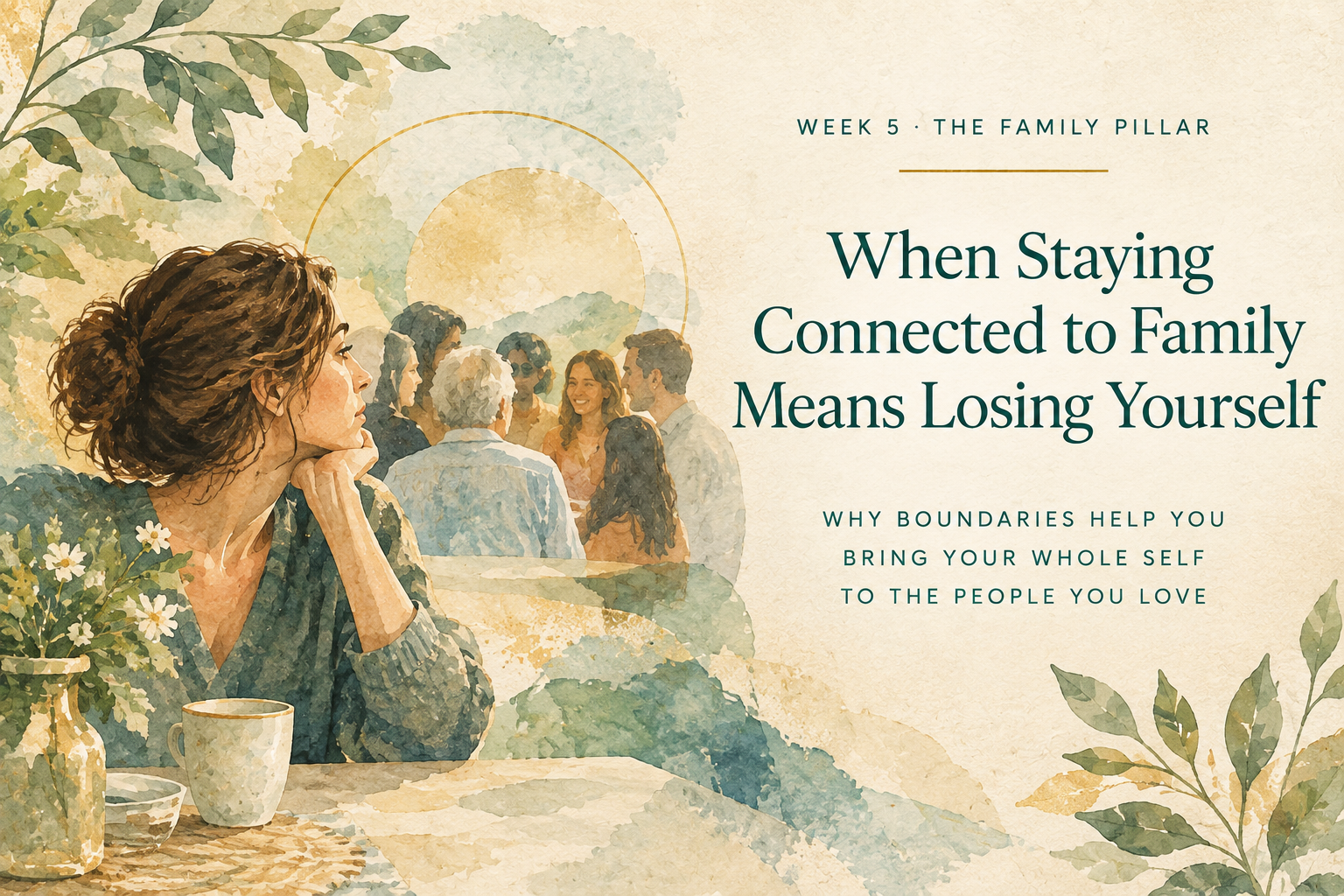
There is a particular kind of exhaustion that comes from a family gathering you were genuinely glad to attend. A woman we'll call Lisa knew that exhaustion well. She loved her family fiercely — a full, loud, three-generation household — and for years she also spent every gathering quietly editing herself: softening an opinion, letting a comment about her sister go, agreeing to a version of the day that kept the room calm. She drove home loved and depleted in equal measure, and for a long time she couldn't quite say why.
Here is why: in a lot of families, staying connected and staying yourself were never offered as a package deal. You could have one or the other. And most of us, as children, chose connection, because a child without connection to their family isn't just unhappy — they're unsafe.
This is the same moment we opened this whole series with: the moment you realize you've been abandoning yourself. Nowhere does that pattern get set earlier, or run deeper, than in family. For Lisa, it showed up most sharply with her youngest sibling, who came out as nonbinary and asked to be called they. Lisa, traditional and blindsided, found the new language beyond her comprehension at first — and rather than risk the relationship, she mostly went quiet about her own confusion and discomfort, reading the room instead of speaking in it.
That adjustment made sense. A child's nervous system — and, it turns out, an adult's under enough pressure — is built for exactly one priority: stay attached to the people who keep you alive. If staying attached meant going quiet about your own experience, your body made that trade instantly, without asking your permission, because it was the right trade for a child to make. The trouble is that most of us are still making it as adults, in rooms where it's no longer required.
What makes this pattern so hard to spot is that it doesn't feel like fear. It feels like love. For Lisa, it felt like being a good daughter, a good sister — like the version of her that kept everyone comfortable was simply who she was in that context. But there's a difference between choosing to set something aside for a moment because it genuinely doesn't matter much, and reflexively erasing yourself because some quieter part of you still believes connection depends on it.
One is generosity. The other is old survival wiring, dressed up as personality.
The instinct, once you notice this pattern, is often to swing hard the other way — to go quiet on the family entirely, or show up armored, bracing for the next moment you'll have to disappear yourself. But as we talked about in Week 4 with Rachel, the real alternative to self-abandonment was never distance. It's a boundary — or what Lisa came to call her protocols: clear agreements with herself about what she was and wasn't willing to discuss, held with love rather than distance.
A boundary lets you stay in the room as yourself. It might sound as small as, “I'm not going to discuss that topic today,” or, “I need to leave by eight.” It doesn't require anyone else's agreement, and it doesn't require you to explain your whole history to get there. It simply lets you bring your actual self to the people you love, instead of the edited version that learned, a long time ago, that this was the price of staying close.
Before your next family gathering, try asking yourself one honest question beforehand: what part of myself do I usually leave at the door here? You don't have to change anything about the visit. Just notice. Noticing is where every version of this work begins — and it's often the only thing standing between you and finally bringing yourself all the way into the room.